BN9: An Obscure Camera
Flexer and Sandiland present An Obscure Camera
Atrium Gallery, Marine Workshops, Newhaven, BN9 0ER
18 to 28 June, Free to attend
Opening times
Thursdays to Saturdays: 10.00am to 4.00pm
Sundays: 10.00am to 3.00pm
Suitable for everyone aged 8 and upwards
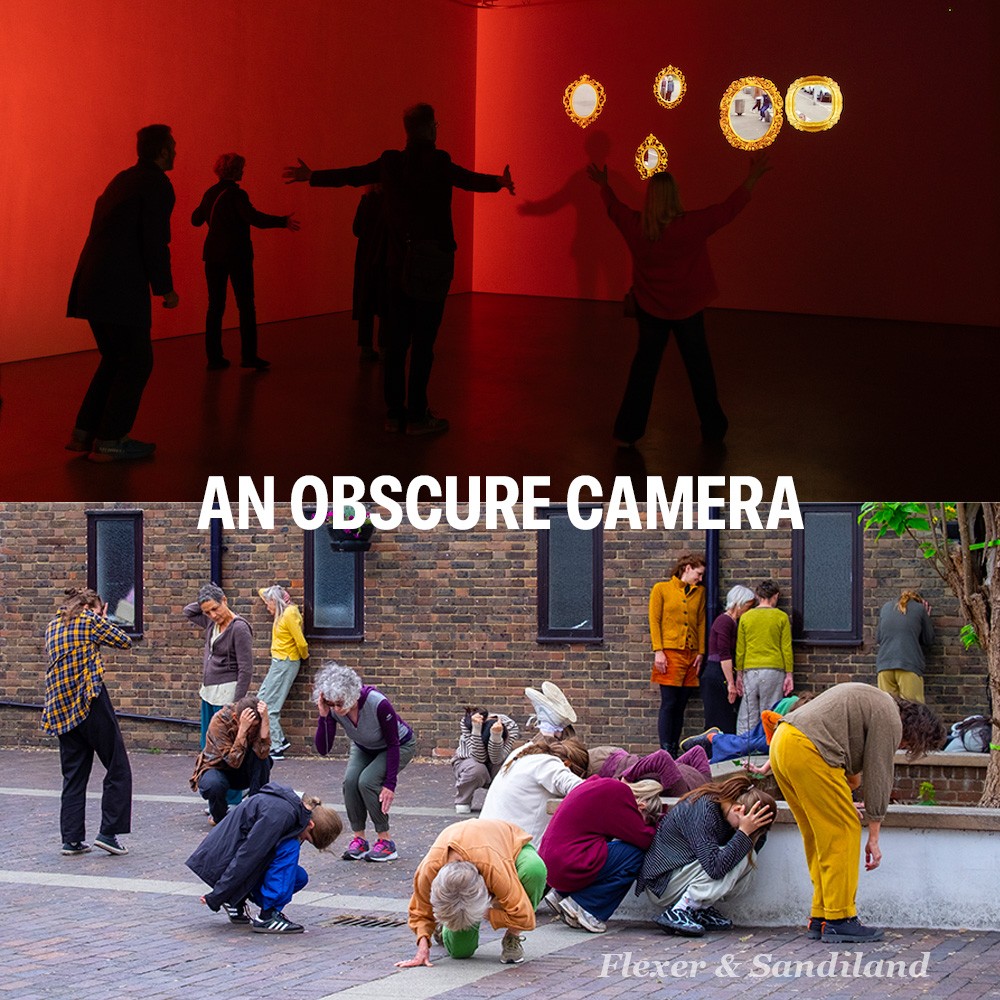
Experience a modern day take on the Camera Obscura at Newhaven’s Marine Workshops. This playful interactive work by artists Yael Flexer & Nic Sandiland responds to your actions as you move within the gallery space, controlling and affecting the live view outside of the building.
Evoking aspects of contemporary surveillance culture, An Obscure Camera gives us the power to explore the surrounding landscape of the Marine Workshops. In doing so, we navigate the fine line between observer and voyeur, physically enacting the choices made by the countless algorithms that analyse our daily lives.
As part of the work Flexer & Sandiland will be staging a community performance-intervention on Saturday 27 June to be experienced through the installation. The company will also be running a dance improvisation workshop open to local participants on the same day.
Community performance-intervention
Saturday 27 June
11.00am to 11.45am: Free Movement Workshop open to all age 14+
12.30pm: Choreographic intervention show 1
13.15: Choreographic intervention show 2
2.00: Nic Sandiland Artist Talk
More about the piece
The fascination with Camera Obscura has captured audience imagination drawing people worldwide from Victorian times to the present day. The spectacle of entering a dark room through which to witness and actively peer out to the surrounding landscape is both theatrically enticing and technically mysterious. An Obscure Camera develops these ideas for a 21st-century context.
We enter a large dark space and are immersed by a multitude of ornate Rococo frames projected onto the surrounding walls and ceiling. Each of these frames contains a close-up view of the live outdoor environment outside of the building. As we walk around the space, the frames move with us, traveling in accordance with our speed and direction. New subjects enter and pass through the frames as their viewpoint changes. We now find that we can begin to scan, track, and follow different features in the outdoor spaces, including its inhabitants, through our motion within the installation.
Evoking aspects of contemporary surveillance culture, the installation gives us the power to explore, seek, and inspect anything and anyone we find interesting. In doing so, we navigate the fine line between observer and voyeur, physically enacting the choices made by the countless algorithms that analyse our daily lives.
Artists Statement
For many years, we have worked with technologies that sense and track the human figure, integrating these tools into our choreographic practice. With the shift from analogue monitoring to today’s digitally networked infrastructures, a new wave of surveillance technologies now dominates both our public and private spaces. This has led us to ask: how can we grasp the ethical implications of systems whose workings are so deeply hidden from public view?
These systems and algorithms - employed by organisations ranging from commercial enterprises to government agencies - aim to recognise, categorise, and track the human figure. Yet the exact way they enact these choices remains opaque. While their function can be described objectively - images analysed and compared against vast datasets - there is little opportunity to understand these processes firsthand as immediate, physical acts.
In An Obscure Camera, we address these interactions on a phenomenological level, focusing on the participant’s physical action and kinaesthetic awareness. Through custom interactive technology, participants are given the agency to embody the algorithm itself. Moving within the installation space, they engage in the act of surveillance directly. In contrast to the minimal gestures of clicking a mouse or pressing a key, participants physically inhabit the role of tracker. In doing so, they are confronted - through their own movement - with the ethical and social realities of following and being followed by systems of corporate and institutional power.